

In this article
Async Isn't a Preference - It's the Operating Model
The founders who get the most from Filipino remote professionals share one operating philosophy: they've stopped treating async as a compromise and started treating it as an architecture. They didn't add async tools on top of a meeting-heavy culture. They rebuilt from the ground up with async as the default, and synchronous interaction as the exception.
That shift changes everything. Your hire's productivity isn't bound by your calendar. Your decisions aren't blocked by timezone gaps. And your information - about project status, blockers, decisions made - is documented and searchable by default, not locked inside someone's head after a call ends.
Here's the complete playbook for how to build and run this kind of team.
Communications Stack: Tools and Protocols
Loom over Zoom for everything non-urgent. If a piece of communication can be delivered without a live call - and most of it can - record a Loom. Walkthroughs, feedback on deliverables, context on a new project direction, onboarding instructions. Loom is indexed, replayable, and doesn't require calendar coordination. Every Loom your remote specialist sends you is a check-in that didn't interrupt your day.
Slack with structure, not Slack as chaos. Most Slack implementations are reactive and noisy. Structure yours intentionally:
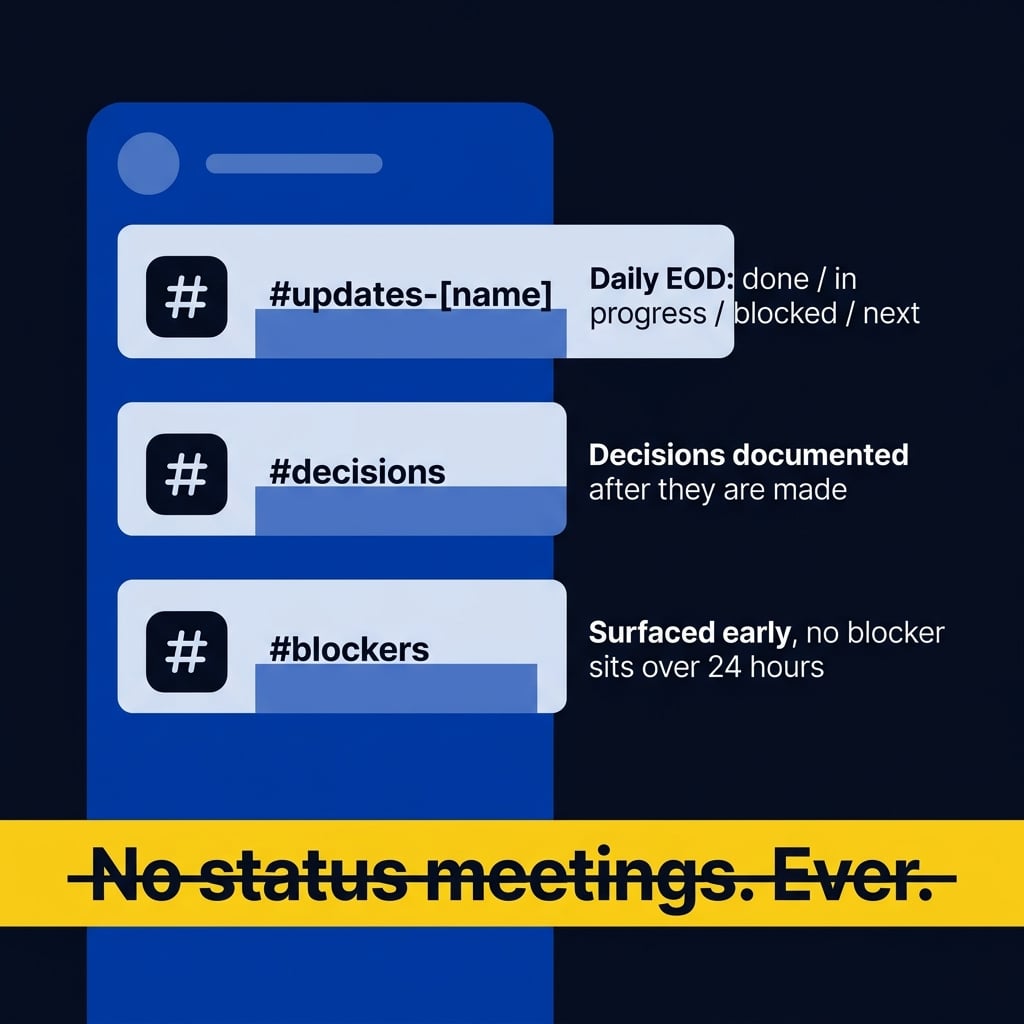
- #updates-[name] - each team member's dedicated async status channel. Daily EOD update: what was completed, what's in progress, what's blocked, what's next.
- #decisions - a channel where decisions are documented after they're made. Not discussed - documented. The context is in the Loom or Notion doc.
- #blockers - surfaced early, resolved with comments. No blocker stays in this channel longer than 24 hours without a response.
No status meetings. Ever. If you can answer "what is everyone working on?" by reading #updates channels from the last 24 hours, you don't need a status meeting. Cancel them. Use the time for deep work.
Documentation First - Before the Hire Starts
The single biggest failure mode for remote team onboarding is documentation that happens after the hire starts. That means your new specialist's first two weeks are spent asking questions you could have answered in a Notion doc. Every question they send you costs you both time and momentum.
Before your FilAm hire's first day, the following must exist in Notion:
- Role context doc: Why this role exists, what success looks like in 30/60/90 days, and how this role connects to company goals.
- Tool stack guide: Every tool they'll touch, with access credentials in 1Password, and a Loom walkthrough for any tool with a non-obvious workflow.
- Communication SOP: How updates work, how to flag blockers, expected response times, and how decisions get made.
- Project runbook: Every recurring process documented step-by-step. If it happens more than once, it has a doc.
This investment takes 4–6 hours before the hire starts and saves 20+ hours in the first month. It also signals to a high-quality hire that you're a high-quality operator. The best Filipino professionals self-select toward organized, documentation-first clients.
KPIs: Results-Based, Not Hours-Based
The most reliable way to create a passive, check-box-oriented remote hire is to measure hours. Hours tell you someone was online. They tell you nothing about whether they moved anything forward.
Define your KPIs at the outcome level:
- Not "work on social content daily" - but "publish 5 high-quality posts per week with avg engagement rate above 2%"
- Not "respond to support tickets" - but "first response time under 2 hours, resolution rate above 85%"
- Not "help with outreach" - but "25 qualified prospects added to pipeline per week"
When the metric is an outcome, the person responsible starts making decisions about how to achieve it - not just executing tasks. That's the behavior that separates an operator from an assistant.
Timezone Overlap: The 4-Hour Window
Philippine Standard Time is UTC+8. US Eastern is UTC-4 to UTC-5. That's a 12–13 hour gap. The math sounds problematic until you design around it.
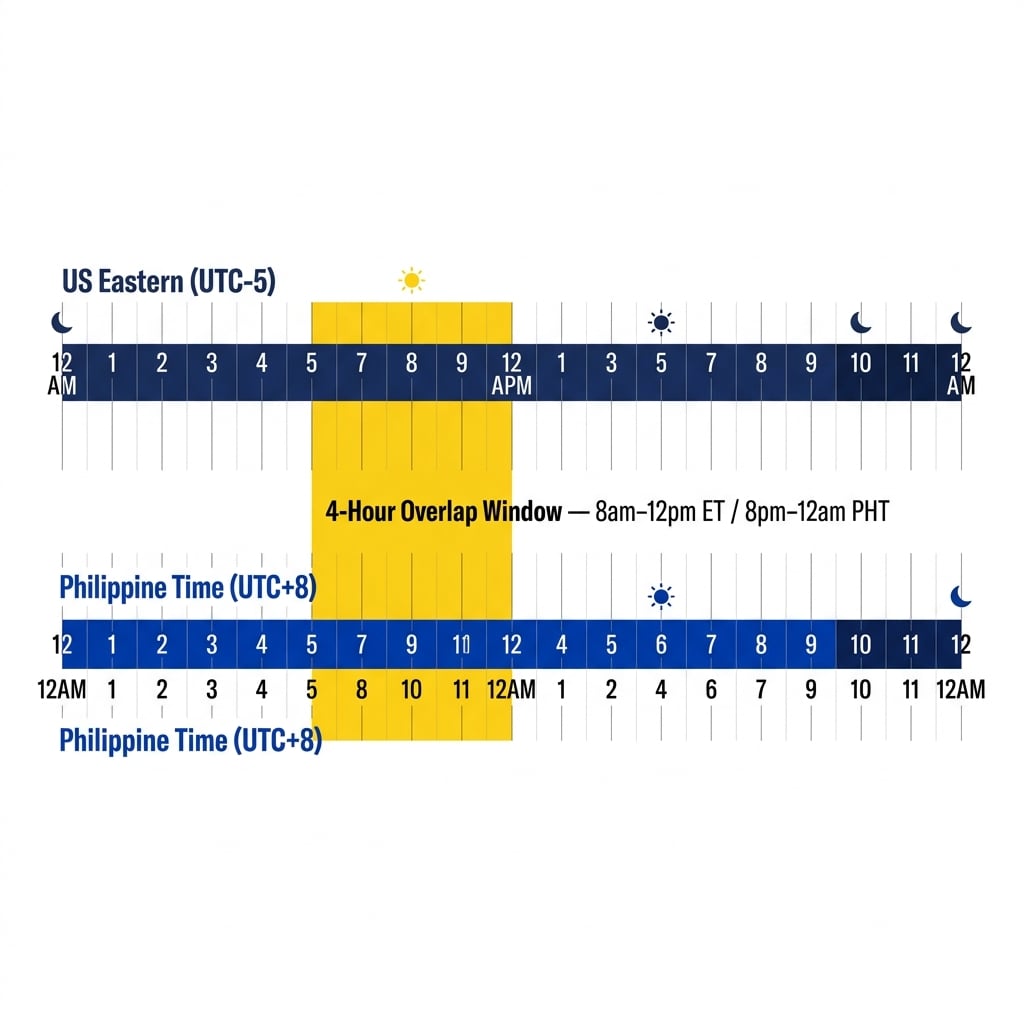
The strategy: establish a shared 4-hour overlap window. For US East Coast teams, this typically means your Filipino team member works a late shift - roughly 8pm–12am PHT, which maps to 8am–12pm ET. For West Coast teams, the window shifts naturally.
That 4-hour window covers your high-priority sync points - morning standup (async Loom, not live call), design reviews, urgent blockers. The remaining 4–5 hours on each end are deep-work blocks that are completely undisturbed.
The founders who complain about timezone friction are trying to run a synchronous team structure on an async schedule. Solve the architecture, not the clock.
14-Day Onboarding Checklist
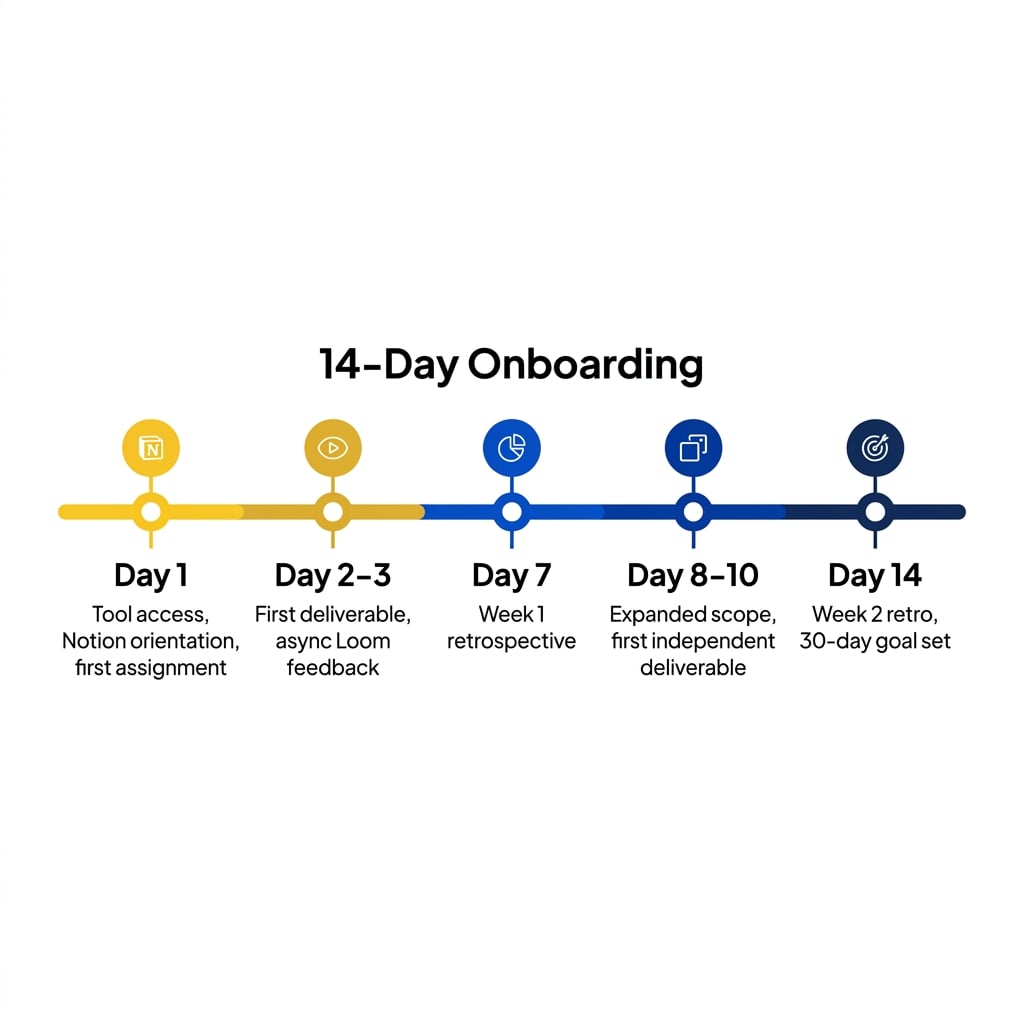
- Day 1: Tool access confirmed, Notion orientation recorded in Loom, intro call (30 min max), first small assignment
- Day 2–3: First deliverable reviewed with async Loom feedback
- Day 4–5: First recurring process handed off with SOP walkthrough
- Day 7: Week 1 retrospective - what worked, what needs clarification, blockers identified
- Day 8–10: Expanded scope, second recurring process, first independent deliverable
- Day 12–13: Performance check vs. 30-day KPIs, feedback loop calibrated
- Day 14: Week 2 retrospective, 30-day goal set and confirmed
By day 14, a high-quality hire is operating with minimal supervision. They know the tools, understand the outcomes they own, and have a cadence for proactive communication. If they're not there by day 14, you either have a documentation gap or a hiring gap - both of which are diagnosable.
Red Flags in the First 30 Days
Not every hire works out, and waiting 90 days to diagnose it is too expensive. Here's what to watch for:
- Consistent late status updates - without proactive notice. Once is a signal. Three times in two weeks is a pattern.
- Blocker-free updates that hide problems - everything looks fine until a deadline slips. That means they're not comfortable surfacing issues, or they don't see them coming.
- Passive execution without contribution - they do what's asked and nothing more. After 30 days, a high-quality hire should be improving their own workflow, not just maintaining it.
Address these directly and early - not in a formal review, but in an async message with specific examples. A high-quality professional will respond, adjust, and grow. A wrong hire will produce vague assurances and the same pattern next week. That's your signal to escalate with FilAm.
The Compounding Return
The async-first system feels like overhead when you're building it. After 30 days, it starts feeling like infrastructure. After 90 days, it runs without you thinking about it.
What you get at the end of that arc: a remote specialist who is producing quality output, proactively improving their own processes, communicating with clarity and frequency, and delivering business outcomes - without requiring your daily attention. That's the leverage point. That's what makes Filipino remote professionals transformative when they're hired and managed correctly.
Build the system first. The results follow the architecture.
Ready to find your match?
FilAm matches you with vetted Filipino professionals in 48 hours. From $5.85/hr.


