

In this article
The Real Problem with Remote Micromanagement
Here's the conversation I have with founders every week: "I hired a remote specialist, and now I'm spending more time managing them than I saved by hiring them." They've added a headcount to reduce their own workload, and somehow ended up more stretched than before.
The instinct is to blame remote work. Maybe they need more check-ins. Maybe they need to be online at the same hours. Maybe a project management tool will fix it. These are the wrong diagnoses applied to a problem that started months earlier - in the hiring decision.
Micromanagement is what happens when you hire for availability instead of autonomy.
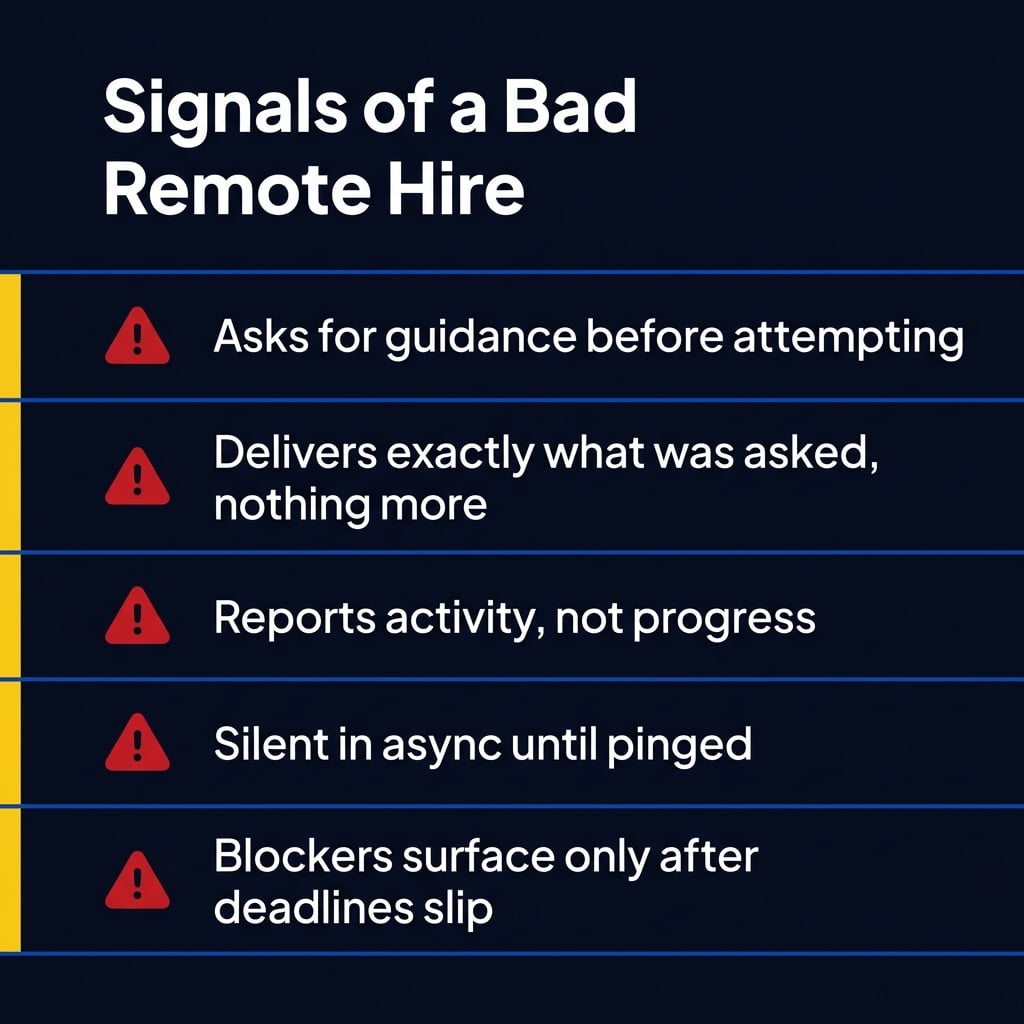
Signals of a Bad Remote Hire
You don't usually know you've hired wrong until 60 days in. By then, you've invested onboarding time, trust, and money. Here are the signals that tell you the hire was misaligned from the start:
- They ask for guidance before attempting. Every ambiguous situation becomes a question directed at you. Not "here's what I think we should do" - just "what do you want me to do?"
- They deliver exactly what was asked and nothing more. No proactive additions. No flagged risks. No suggestions. They treated a deliverable like a transaction, not a contribution.
- Status updates report activity, not progress. "I worked on the campaign today" instead of "The campaign is at 68% of monthly target, here's why, here's what I'm doing about it."
- They disappear from async comms until directly pinged. Long silences, no proactive Slack updates, no Loom walkthroughs. Presence only when prompted.
- Blockers surface only after deadlines slip. A self-directed professional flags blockers early. A passive one absorbs them quietly and delivers late.
If you recognize three or more of those patterns in your current remote hire, the micromanagement dynamic you're experiencing isn't fixable by changing your management approach. The hire was wrong.
What Extreme Ownership Actually Looks Like
Extreme ownership is a hiring criterion, not a management outcome. You can't coach someone into it after the fact - not at the speed modern remote teams need to move. Here's what it looks like in practice, across specific roles:
An ownership-oriented ops coordinator doesn't wait for you to identify process gaps. They run a workflow, notice inefficiency, document a proposed improvement, and ship it in Notion - then ping you to review. You didn't ask. They identified leverage and acted on it.
An ownership-oriented digital marketer doesn't just execute the campaign brief. They return with data you didn't ask for, a recommendation you didn't commission, and a test hypothesis they want to run next month. They're managing the outcome, not the task.
An ownership-oriented SDR doesn't just work the sequence. They A/B test subject lines, flag the ICP signals that are converting better, and bring you a competitor insight they noticed in a prospect conversation - without a meeting or a prompt.
The common thread: they're thinking about results, not tasks. They treat your business outcomes as their own responsibility. That's the behavior you need to hire for, and it's identifiable in a well-designed interview and vetting process.

How We Vet for This Specifically
At FilAm, our vetting process is built around a core question: does this professional operate autonomously when given clear objectives, or do they require step-by-step instruction?
We use structured scenario questions that surface the difference. Not "describe your communication style" - that surfaces rehearsed answers. Instead: "Walk me through a project where a key assumption turned out to be wrong. What did you do before you had guidance from your manager?" That answer tells you everything.
We also use async assessment exercises. We give candidates a real problem with intentionally incomplete information and observe what they do. Do they ask clarifying questions before attempting? Do they make stated assumptions and push forward? Do they deliver something useful despite the ambiguity, or do they stall?
The combination - scenario interviews plus async real-work exercises - filters for ownership at a rate that generic job boards simply can't replicate. By the time a candidate reaches you, you're choosing between people who've already demonstrated autonomy under conditions designed to reveal the opposite.
The Fix: Hire for Autonomy, Structure for Accountability
If you've been micromanaging a remote team, your next hire needs to be built differently from the first one. Here's the decision framework:
- Rewrite your job criteria. Remove availability requirements. Add ownership signals: "independently manages delivery timelines," "proactively surfaces risks before they become blockers," "drives projects without daily check-ins."
- Test for initiative in the process. Give candidates an async task with minimal guidance. Watch how they handle the gaps. The right person will make reasonable assumptions, flag them clearly, and deliver something useful. The wrong person will stall.
- Set outcome-based KPIs from day one. Not hours worked, not tasks completed - results achieved. When the measurement is tied to outcomes, you automatically filter for the kind of person who cares about outcomes.
- Build your async stack before they start. Notion for documentation, Loom for async walkthroughs, Slack with structured update protocols. When the environment rewards self-direction, you attract people who thrive in it.
Micromanagement feels like a management problem. It's actually a hiring problem with a management symptom. Fix the hire, and the management becomes what it should always be: light, strategic, and focused on outcomes rather than oversight.
Stop hiring bodies. Start hiring operators.
Ready to find your match?
FilAm matches you with vetted Filipino professionals in 48 hours. From $5.85/hr.


